


FORM AND FUNCTION IN ARCHITECTURE II
The form and function is the topic that a architect would look into. To be an architect of information solutions is to understand the concept of form following function intuitively, as a matter of nature, because design (creation of form) is about enabling informational function.
Many architects have a signature style that can be seen in the forms they choose to create. Depending on the project or the client, they may focus mainly on accommodating a certain function or on creating an interesting spatial experience.
But what is the relationship between form and function over lifespan of an architectural work? For my knowing, basically the buildings which getting renovated, adaptive reuse or extended are the old style of architecture compared to architecture today.
The form and function of an old building is based on the understanding, knowledge and also the requirement and needs of the owner in the old days. The reason why the buildings getting renovated is because the "old" function and form of the building is not sustainable anymore nowadays. The acknowledge for the people from past and now on the function and form of a building is different.
From the article that written by Peter Eisenman, he mentioned because of the rise of industrialization, it had of necessity to come to terms with problems of a more complex functional nature, architecture became increasingly a social or programmatic art. And as the functions became more complex, the ability to manifest the pure type-form eroded.
The renovation, adapting and reuse is one of the way for the old building or a purpose other than which it was built designed for comes in as an sustainable option for the reclamation of sites. The function and the form will be changed after the renovation, adapting and reuse to other purpose and appearance.
The lifespan for whether is big or small scale of a building will always to the end. Here is one of the example that really catching my attention although I am not even involved in this renovation and adaptive reuse project. The purpose of this project is converting a normal double storey shop house into a field school for the locals kids and adult.

This is the double storey shop house which located at Seberang Kuala Sepetang that has been abandoned and not operating anymore. Because of the population and human flow in that area, the owner decided to end the business and agreed to convert the building to other "function".

The floor panels are all removed but the main supporting structure is remaining. The designer decided to not demolished the entire building but reuse and recreate the spaces for the different purposes and function from the previous functions.

Reclaiming the materials from the existing structure and reuse it for the other purposes.
By reusing an existing structure within a site, the energy required to create these spaces is lessened, as is the material waste that comes from destroying old sites and rebuilding using new materials.
Through adaptive reuse old, unoccupied buildings can become suitable sites for many different types of use.

After the renovation, the building not only has the new function but the form also changed. They apply the facade in the building by using the material that reclaiming from the existing structure.
13781822_10154275357559831_8231206394101548847_n 12079248_10153609079029831_4726552390571564492_n 12106972_10153609083669831_4918619402360612687_n 12495168_10153796337204831_4383839264556934105_n
Now the function of the building is totally different from the existing purpose. They named the building Kaktao46, Corner46 that came from the site being a corner unit and the number 46 is the lot number of the site where many exciting events and happenings will be hosted here. Featuring spaces include an exhibition area, a library for the local kids to have their learning sessions and activities, and also a hands-on architecture workshop for UCSI and CYCU students.
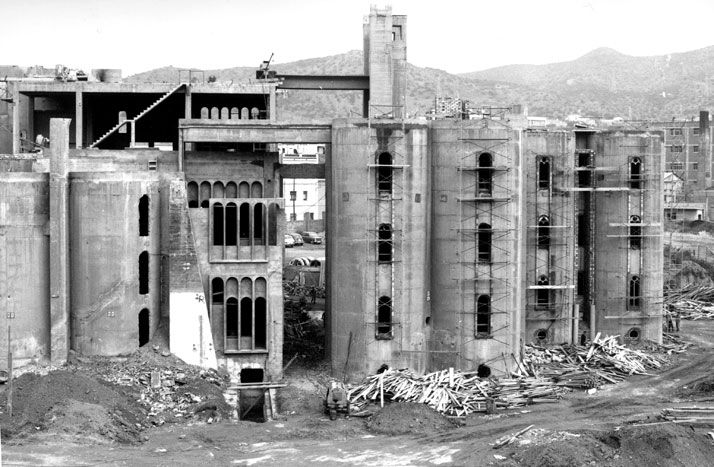
This is the another example that has the bigger scale from the previous one. The existing function of this building is a cement factory and this is the building condition that the owner, Ricardo Bofill bought it in 1973. It was an abandoned cement factory and partially in ruins, comprised of over 30 silos, underground galleries and huge engine rooms, and he decided to transform it into the head office of Taller de Arquitectura.
Ricardo-Bofill-cement-factory-yatzer-7 Ricardo-Bofill-cement-factory-yatzer-10 Ricardo-Bofill-cement-factory-yatzer-6 Ricardo_Bofill_Taller_Arquitectura_SantJustDesvern_Barcelona_Spain_PrivateSpaces_(7)
Ricardo Bofill also the architect of this project, he identified the program; the cement factory was to be used as architectural offices, archives, a model laboratory, and exhibition space, an apartment for him, as well as guest rooms and gardens.
The transformation process began with the demolition of part of the old structure to leave hitherto concealed forms visible, as if the concrete had been sculpted. Once the spaces had been defined, cleaned of cement and encompassed by new greenery, the process began of adaptation to the new programme.
This project is evidence of the fact that an imaginative architect may adapt any space to a new function, no matter how different it may be from the original one.


Comments