


Architecture Upcycling
After years in the (re)making, it appears that the age of architectural upcycling is upon us. According to in-depth research into last year’s A+Award-winning projects — available as a free-to-download report courtesy of creative analysts PSFK — an increasing number of firms are reacting against the throwaway culture proliferating in modern cities throughout the developed world, finding increasingly radical ways to reuse existing infrastructure, aging industrial buildings, and redundant materials
The quiet revolution where adaptive reuse and renovation have become a trend in today’s architecture. The fact is further proven with the study that in the next 10 years, 90 percent of the United States construction will occur on the existing building (renovation or adaptive reuse). Risk-adverse developers and building owners are opting to repurpose older buildings. In some situations, it is more financially and intrinsically advantageous to repurpose an existing building than it is to knock it down and replace it with another.
Buildings are responses to purpose, but the purpose changes in response with time and the socioeconomic circumstances. Changing in purpose meaning changing in function of the building, or we should call it the change in the “pedagogic system”.
To distinguish the ambiguity of the term “function” and “purpose”, quote taken from the article-“Purpose, Function, Use” by Richard Hill best defines the two terms. “Purpose denotes a human intention in relation to an object, and function denotes the object’s execution of that purpose.”
There are a few cases upon adaptive reuse, first, the form is remained but the function is changed, secondly, the function and form are remained with new function introduced into it and thirdly the form and function both change, but with the form adapting to the site (using the grid system of the previous building or the structures are remained)
Form remained, function changes
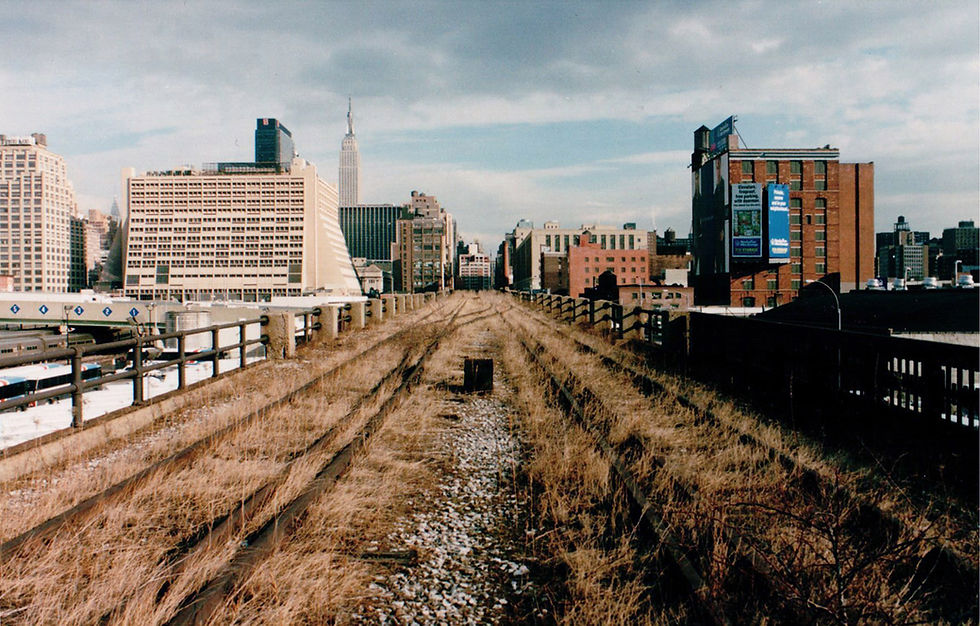
The High Line
The High Line is an elevated section of a disused New York Central Railroad spur called the West Side Line transformed into a 2.33km long New York City linear park on Manhattan’s West Side. The project has spurred real estate development in the neighbourhoods that lie along the line, and increased real estate values and prices along the route, as a "halo effect". As of September 2014, the park gets nearly 5 million visitors annually. In this case, besides from changing in the function of the spaces, the site surrounding and contest also changes upon the renovation and reuse of the railway.

Refurbishment of the Old Benalúa Station and Insertion of Casa Mediterraneo Headquarters
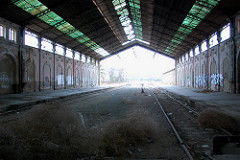
Remaining the Old Benalúa Station, the new institution demanded new spaces where to develop a wide range of events, including exhibitions, concerts, shows or parties is introduced. The former platform hall is intended to become a experience hall. The unused, rusty, dark and dry space becomes blue, excited, liquid, vibrant, unstable, overflowing, zenithal, rythmic, programmable, thermodynamic and profitable. Besides, the conventional programme is fitted into an array of climatized small pavilions scattered along the perimetral aisles.

Form and Function both changes
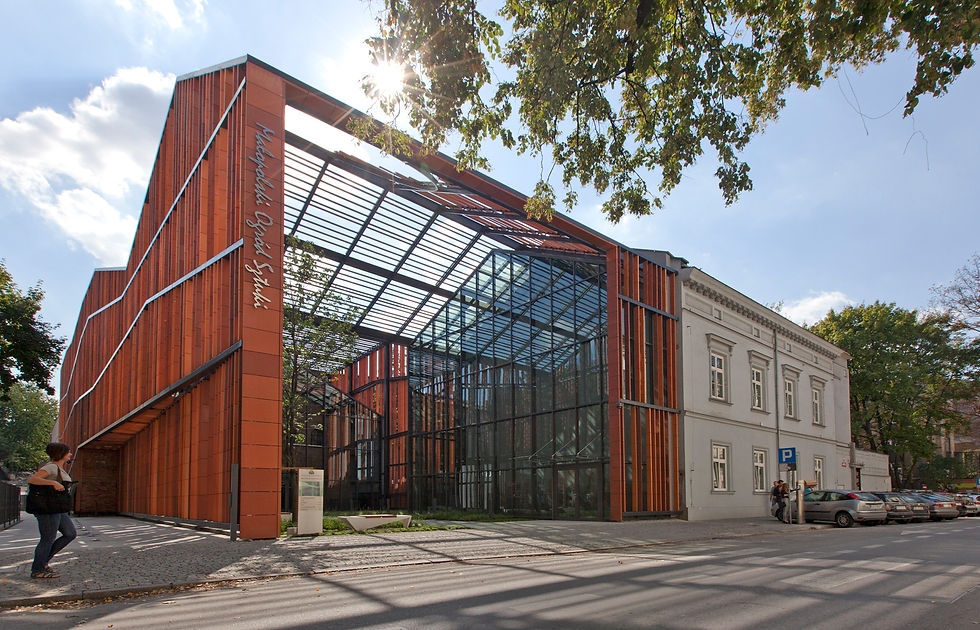
The Malopolska Garden of Art, Krakow, Poland
The MGA is a physical and institutional hybrid between Juliusz Słowacki Theatre and the Malopolska Voivodeship Library. The library is situated in the western, or vertical, wing of the T-shape, while the theatre stretches north to south, horizontally. The new theatre embellishes upon a renovation of an old storage facility to an adaptable hi-tech venue that can operate an as a studio theatre, conference center, or exhibition space. The library has a separate entrance fitted to the sidewalk, bordering an additional garden passageway to a side entrance of the theatre.
The building does not literally resurrect its form from its context, but uses it as an inspirational reference of geometry and composition of its neighbouring facades. Following the code of scale and respecting existing linear elements allows the contemporary materials to appear in a conversation with the surrounding neighbourhood.

To coclude, these projects demonstrate how many firms are becoming increasingly adept at adaptive reuse within dense urban areas, a specialist discipline that is only becoming more vital as our cities increase in density and land prices also increase. Significantly, though, these practical advantages are being accompanied by cutting-edge design that is as fashionable as it is pragmatic. The second lives of buildings around the world are only beginning, and they are being reborn as urban exemplars of style and sophistication.


Comments